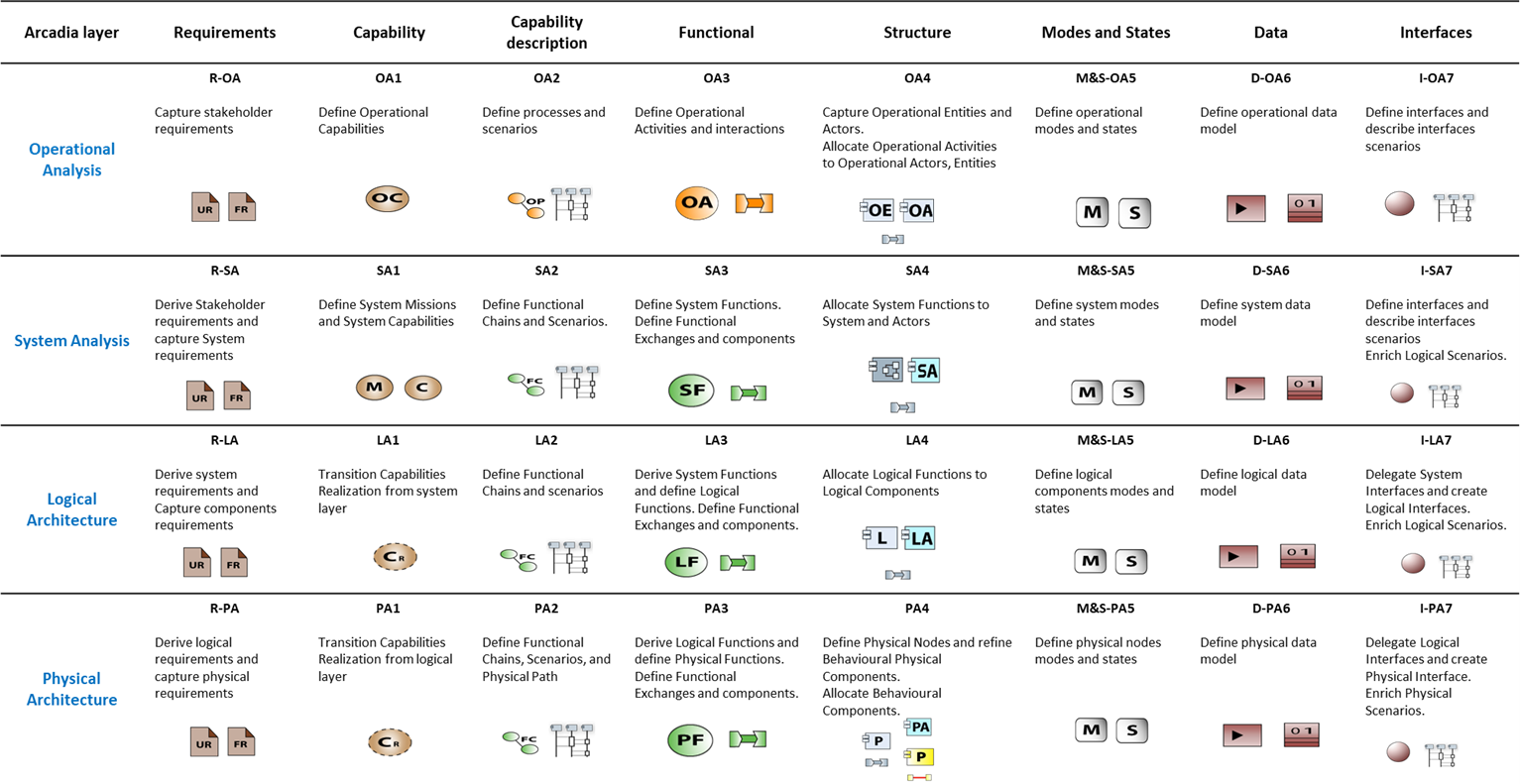
Arcadia is a tooled method devoted to systems & architecture engineering, supported by Capella modelling tool.
It describes the detailed reasoning to
It can be applied to complex systems, equipment, software or hardware architecture definition, especially those dealing with strong constraints to be reconciled (cost, performance, safety, security, reuse, consumption, weight…).
It is intended to be used by most stakeholders in system/product/software or hardware definition and IVVQ as their common engineering reference and collaboration support.
Arcadia stands for ARChitecture Analysis and Design Integrated Approach.
A series of online documents to dive into the principles and concepts of Arcadia:
Arcadia is a system engineering method based on the use of models, with a focus on the collaborative definition, evaluation and exploitation of its architecture.
This book describes the fundamentals of the method and its contribution to engineering issues such as requirements management, product line, system supervision, and integration, verification and validation (IVV). It provides a reference for the modeling language defined by Arcadia.
Jean-Luc Voirin, leader of the creation of the Arcadia method, along with some of the leaders on developing and deploying MBSE Arcadia & Capella practices in Thales. From right to left: Pierre Nowodzienski, Jean-Luc Voirin, Juan Navas, Stephane Bonnet, Frederic Maraux, Gerald Garcia, Philippe Fournies, Eric Lepicier.
Architecture as prime engineering driver
Arcadia, a model-based engineering method
Noticeable features of Arcadia
Definition of the Problem - Customer Operational Need Analysis
Formalization of system requirements - System Need Analysis
Development of System Architectural Design - Logical Architecture (Notional Solution)
Development of System Architecture - Physical Architecture
Formalize Components Requirements - Contracts for Development and IVVQ
Co-Engineering, Sub-Contracting and Multi-Level Engineering
Adaptation of Arcadia to Dedicated Domains, Contexts, Etc.
Equivalences and Differences between SysML and Arcadia/Capella
The rise of social media platforms has given birth to various online cultures and trends. One such phenomenon is the "Kompilasi Cewek Hijab" (Compilation of Hijab-Wearing Girls) on TikTok, which has gained significant attention in Indonesia. This study aims to explore the context and implications of this trend, particularly in relation to the "scandal" surrounding omek (a type of intimate gesture) and VCS (Video Call Sex) content. Using a qualitative approach, this research examines the online behavior and interactions of hijab-wearing women on TikTok, shedding light on the complexities of online culture, identity, and modesty.
: TikTok has been a platform where users can express themselves in various ways, including through fashion and the use of hijab. Many users showcase their style and how hijab is an integral part of their identity. The rise of social media platforms has given
: For many individuals, especially women, wearing a hijab is a significant aspect of their identity, reflecting their cultural, religious, or personal beliefs. In digital spaces, this aspect of identity can be a powerful form of self-expression. Using a qualitative approach, this research examines the
In recent years, social media platforms have become an integral part of our lives. With the advent of smartphones and internet connectivity, people can now access and share information like never before. TikTok, in particular, has gained immense popularity among younger generations, with its short-form videos and user-friendly interface. : For many individuals, especially women, wearing a